Research
Overview
- SKA precursor science: WALLABY, DINGO, GASKAP, and MHONGOOSE
- Structure and evolution of galaxies
- The Magellanic Stream and high-velocity clouds
- Probing halo gas through Ca ii and Na i absorption
- Source finding and parametrisation
SKA precursor science
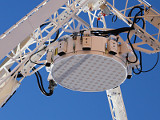 The Australian Square Kilometre Array Pathfinder (ASKAP) is a next-generation radio telescope and SKA precursor currently being constructed by CSIRO in the Murchison region of Western Australia. Once completed, ASKAP will be a powerful survey instrument capable of mapping the H i emission of galaxies across the entire sky and out to redshifts of up to z ~ 0.1.
I am actively involved in several of the H i survey science projects with ASKAP and several more projects with MeerKAT, the South African SKA precursor telescope:
- WALLABY – the ASKAP H i all-sky survey
- DINGO – the ASKAP deep H i survey
- GASKAP – the ASKAP Galactic and Magellanic H i survey
- MHONGOOSE – deep H i observations of nearby galaxies with MeerKAT
- MIGHTEE – MeerKAT international gigahertz tiered extragalactic exploration survey
- LADUMA – the MeerKAT deep H i survey
Structure and evolution of galaxies
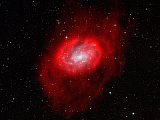 If we believe in the ΛCDM paradigm, then structure in the universe should have evolved in a hierarchical manner. In this scenario, small dark-matter haloes are expected to form first and later merge and accrete onto larger haloes to form more massive galaxies like the Milky Way. Due to its general abundance, widespread distribution, and susceptibility to ram pressure, neutral hydrogen is a particularly good tracer of the merging and accretion history of galaxies.
- Structure formation in the Sculptor group
- IMAGINE – ATCA H i survey of spiral galaxies
The Magellanic Stream and high-velocity clouds
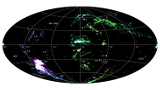 Our Milky Way is surrounded by a vast population of gas clouds, called high-velocity clouds (HVCs), that are mainly detectable in H i emission. The most famous HVC complex of the Milky Way is the Magellanic Stream, thought to be a system of tidal arms originating from the Magellanic Clouds. My main research interests are in the study of the extended filaments of the Magellanic Stream as well as the search for HVC populations around other, nearby galaxies, in particular the Andromeda galaxy.
- All-sky map of high-velocity clouds
- Compact high-velocity clouds around the Milky Way
- The extended filaments of the Magellanic Stream
- High-velocity clouds around the Andromeda Galaxy
Probing halo gas through Ca ii and Na i absorption
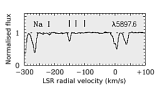 During the last decades, absorption and emission line measurements have demonstrated that the Milky Way is surrounded by a complex, multi-phase gaseous halo. Embedded in a corona of million-degree gas, neutral and ionised gas clouds move with high radial velocities through the Milky Way halo, giving rise to the population of IVCs and HVCs.
Source finding and parametrisation
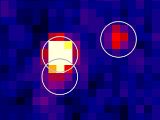 The next generation of radio telescopes, such as the Square Kilometre Array (SKA), will produce unprecedented quantities of data that cannot be inspected by eye any longer. Instead, fully automated pipelines will be required to detect and analyse sources. As part of my contribution to the WALLABY and DINGO projects on ASKAP I am actively involved in developing and testing automated source finding and parametrisation algorithms.