Research
Structure formation in the Sculptor Group
Introduction
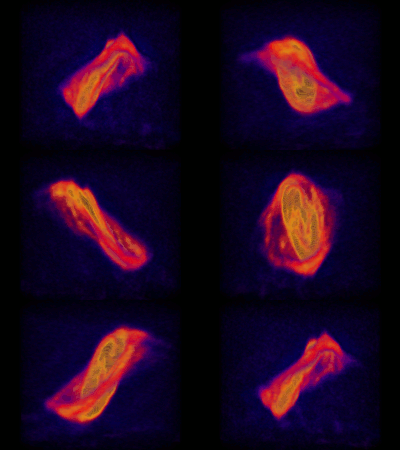 The aim of this project is to study the nearest spiral galaxies in the nearby Sculptor Group in neutral hydrogen with the ATCA to search for high-velocity clouds (HVCs) and extra-planar gas in their environment. HVCs could be primordial, dark-matter-dominated satellites, the remnants of tidal stripping in the vicinity of larger galaxies, or the result of galactic winds and outflows. Studying the HVCs of other galaxies is the most promising way to find evidence for the different proposed formation scenarios for the following reasons:
- We look at the HVC population of an external galaxy from the outside. Therefore, we can directly determine the (projected) radial distribution of HVCs. This is impossible for the HVCs of our Milky Way, because we are sitting within the Galaxy.
- The distances of nearby galaxies and their potential HVC populations are usually well known, allowing us to directly determine important physical parameters of the HVCs, such as their H i masses or diameters.
- The Sculptor Group is the nearest galaxy group. The relatively small distances of the Sculptor Group galaxies will therefore allow us to achieve high H i mass sensitivities of the order of 105 M☉ with moderate integration times at the ATCA.
Therefore, we have mapped a large area of almost 2° × 2° around the two nearest large Sculptor Group galaxies, NGC 55 and NGC 300, with the ATCA in mosaicking mode. At a moderate spatial resolution of about 1 kpc, the resulting maps are among the most sensitive H i images of external galaxies ever made. Some of the discoveries made in the data include:
-
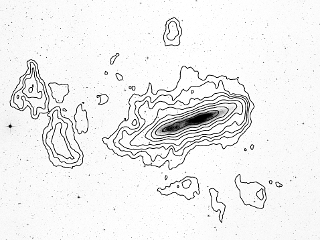 We found several gas clouds in the vicinity of NGC 55, some of which are presumably HVCs associated with the galaxy, while others might be foreground objects associated with the Magellanic stream.
- The HVCs of NGC 55 are not likely to be primordial dark-matter haloes, but have presumably been generated in interaction or outflow processes, possibly as the result of the accretion of one or more satellite galaxies by NGC 55.
- The outer H i disc of both NGC 55 and NGC 300 shows distortions that are consistent with ram-pressure stripping, suggesting that the ram-pressure forces exerted by the intergalactic medium of the Sculptor group has an impact on the gas discs of galaxies in the group.