
The IAU Working Group on Astronomical Data
The Working Group on Astronomical Data (WGAD) of the International Astronomical Union (IAU) is a working group concerned with issues around the access of astronomical data. Current issues include:
- Promoting open access to observatory archives
- Promoting the concept of the Virtual Observatory
- Promoting common formats for astronomical data to facilitate sharing and entry into public-domain databases
- Discussing the implications (for data centres, for the VO, for astronomers) of future terabyte astronomical databases.
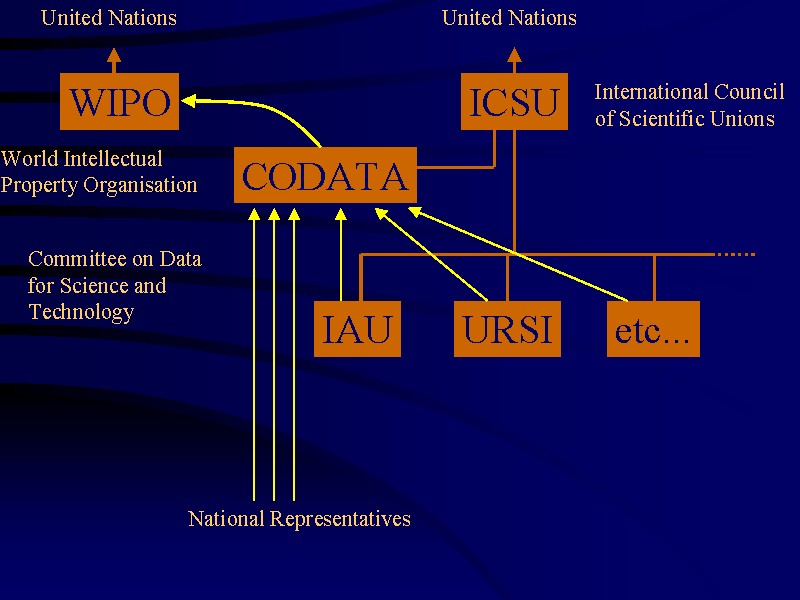
The WGAD, chaired by Ray Norris, is a working group of Commission 5 of the IAU. The chair of the WGAD also represents the IAU on CODATA (the ICSU Committee on Data for Science and Technology).
Current Documents
- Astrodata wiki discussion
- CODATA Report to IAU 2009
- IAU Triennial report 2006-9 on the Working Group on Astronomical Data
- Report to the IAU on 2007-8 CODATA Activities
- CODATA Draft Strategic Plan
- ICSU Strategic Committee on Information and Data
- List of members of the WGAD
- The Astronomers’ Data Manifesto
Archive Documents
- IAU Report to CODATA on Astronomical data Management, October 2006
- Astrodata wiki discussion 2005-7
- Report from CODATA 2006, Beijing, by Brian McMahon
- IAU GA Prague, August 2006: WGAD meetings
- IAU GA
Prague - Paper on the Management of Astronomical Data (in IAU Bulletin 96)
- 2004 Report from the IAU to CODATA
- Resolution on freedom of access to astronomical archives (proposed by WGAD, and adopted by IAU General Assembly, July 2003)
- 2002Report from the IAU to CODATA
- 2002Report from WGAD to the IAU
- Notes and presentations from the WGAD meeting held in Manchester in August 2000 at the IAU GA
- Report of the WGAD to CODATA, June 2000, by Ernst Raimond
- Diagram showing the relationship between the IAU, CODATA, and other bodies
- List of past chairmen of the WGAD
Threats to Freedom of Access to Public-Domain Databases
- Our current freedom of access to public-domain astronomical databases was threatened in 2000-2 by poorly-conceived treaties and legislation proposed by WIPO, the European Union, and other bodies. See here and here for more info. At present, the threat appears to have diminished, thanks to some quick and effective action by members of CODATA and other bodies, but we need to remain vigilant that the threat does not re-appear.
Last updated by Ray Norris, 29 April 2009
Staff space
Public