ATNF Pulsar Catalogue v2.8.1: Documentation
G. Hobbs, R. N. Manchester, L. Toomey and A. KapurCSIRO Space & Astronomy, Australia Telescope National Facility, PO Box 76, Epping, NSW 1710, Australia
NOTE: psrqpy, a Python package for interacting with the ATNF Pulsar Catalogue is also available (https://psrqpy.readthedocs.io/en/latest/)
1. Introduction
Background to the original (2005) version of the ATNF Pulsar Catalogue
Since publication of the "Catalog of 558 Pulsars" by J.H. Taylor, R.N. Manchester & A.G. Lyne in 1993 (ApJ Suppl. Ser., 88, 529-568), the number of known pulsars has increased considerably. Although various researchers have maintained updated catalogues since then, in general, these have neither been complete, nor very accessible. One of the more complete databases has been maintained principally by ourselves and colleagues at the University of Manchester, Jodrell Bank Observatory. This database, based on one originally developed at the University of Massachusetts (Manchester & Taylor 1972, Astrophys. Lett., 10, 67-70), is a simple keyword, parameter ascii file containing references to the source of the data. We have used this as a basis for the present catalogue. With the invaluable help of NASA's Astrophysics Data System, we have done an exhaustive search of the pulsar literature, at least back to 1993 to (hopefully) find all papers announcing the discovery of pulsars or giving improved parameters for them. Data from these papers has been entered into the catalogue database.General description of the Catalogue
The catalogue includes all published rotation-powered pulsars, including those detected only at high energies. It also includes Anomalous X-ray Pulsars (AXPs) and Soft Gamma-ray Repeaters (SGRs) for which coherent pulsations have been detected. However, it excludes accretion-powered pulsars such as Her X-1 and the X-ray millisecond pulsars, for example, SAX J1808.4-3658 (Wijnands & van der Klis, Nature, 394, 344, 1998).The catalogue can be accessed in a number of different ways. The simplest is from a web interface ( https://www.atnf.csiro.au/research/pulsar/psrcat ) allowing listing of the most commonly used pulsar parameters, their uncertainties and reference information. Several options for tabular output format are provided. Currently, a total of 69 predefined parameters are available, with a further 105 in "Expert" mode: see the parameter list in Appendix A of this help file. A facility is provided for plotting of parameter distributions as two-dimensional plots. Zoom facilities and interactive identication of plotted points are provided. Custom parameters can be defined by combining parameters in expressions using mathematical operators and functions and these can be either listed or plotted. Finally, the sample of pulsars listed or plotted can be limited by logical conditions on parameters, pulsar name (including wild-card names) or distance from a nominated position. These facilities are described in more detail below and links are provided within the web interface to relevant documentation.
After creating a table or plot, accessing the help pages or reference list, use your browser Back funtion to return to the main catalogue page.
For professional astronomers, a more detailed "Expert" web interface is available allowing access to an additional 98 parameters of specialist interest. The catalogue can also be accessed using a command-line interface on unix or linux systems. A tar file containing the database and source files for the command-line program is available using the web interface "Download" link.
A table of the basic parameters for known pulsar glitches is also available from the web interface.
The purpose of this documentation is to provide a description of all the features available. A more basic tutorial is available to guide the user through the web interface (https://www.atnf.csiro.au/research/pulsar/psrcat/tutorial/intro.html). We encourage you to send us as much feedback (both positive and negative) as possible about the catalogue, interfaces and documentation.
PLEASE NOTE: If you make use of the ATNF Pulsar Catalogue in a
publication, we request that you acknowledge the source of the
information by referencing the paper: Manchester, R. N., Hobbs,
G. B., Teoh, A. & Hobbs, M., Astron. J., 129, 1993-2006 (2005)
(astro-ph/0412641), which gives a full description of the catalogue, and
by quoting the web address
https://www.atnf.csiro.au/research/pulsar/psrcat.
Where practicable, please list the original references for data
used. Reference lists for data in a given table, both in plain text
and in .bbl format, are available from links at the bottom of the table
page.
2. The WEB interface
The public web interface is situated at https://www.atnf.csiro.au/research/pulsar/psrcat/. The following sections describe the web interface in detail.2.1 Display Parameters
2.1.1 Predefined Variables
Pulsar parameters are selected by clicking on the box to the left of the parameter label. In the following example, the user has selected to display the pulsars' names and proper motions:
Clicking on the pulsar name gives links to other databases which
may contain information about this pulsar. Clicking on a parameter
name brings up the list of parameter descriptions
(Appendix A) in which the selected parameter
is highlighted in red.
2.1.2 Custom Variables
Custom variables are functions of the predefined variables. Up to four custom variables (C1, C2, C3 and C4) may be defined. The definition is provided in the text box. Valid expressions for this definition are given in Section 3 of this documentation. This custom variable can subsequently be used in sorting, conditions or plotted output. If the check-box to the left of the custom variable label is checked then this variable will be listed in any tabular output (in exponential form to 6 decimal places). For example, a new variable (C1) can be defined to equal the square root of the period multiplied by its derivative -- enter into one of the C1, C2, C3 or C4 text boxes sqrt(p0*p1) and click on the check-box to the left of the text: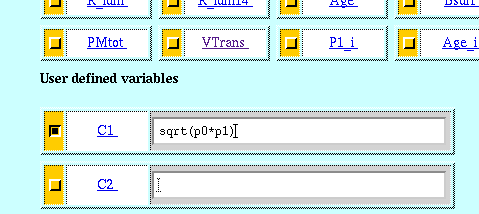
2.2 Sorting
By default the results will be sorted according to the pulsars' J2000 names in ascending alphabetical order. However, sorting is possible on any parameter by typing the parameter label in the 'sort on field' text box and selecting whether the sort should be in ascending (default) or descending order. Sorting may be either numerical, e.g. for pulse period, or alphabetical, e.g. for survey. If the user selects a parameter for sorting that has not been measured for some pulsars (for example, not all pulsars have a measured period derivative) then those pulsars with no measurement will appear at the top (or bottom for descending order) of the sorted table; the remaining pulsars will be sorted correctly. For example, the following would be used to produce a table sorted in descending order on dispersion measure: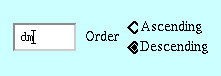
2.3 Logical Conditions
Often the user will require results from only a selection of pulsars in the catalogue. Filtering can be carried out on the pulsars' parameters (described in this section), by the pulsars' names (Section 2.4) or by their position (Section 2.5). The conditional expression can be any valid expression with the following conditional statements:| == | Equality | != | Inequality test |
| < | Less than | ! | Logical NOT |
| <= | Less than or equal to | && | Logical AND |
| > | Greater than | || | Logical OR |
| >= | Greater than or equal to |
along with the following functions:
- exist(par), which returns whether the pulsar parameter (par) is recorded in the catalogue. For example to list all binary pulsars with measured proper motions use:
- error(par) can be used to obtain the uncertainty on a parameter. For example, in order to obtain all pulsars with proper motion measurements in right ascension with uncertainties less than 20 mas/yr, use:
- type(str) allows the type of pulsar to be selected. Currently avaiable types are listed in Appendix B.
- bincomp(str) allows the type of binary companion to be selected. Currently avaiable types are listed in Appendix C.
- assoc(str) is true if 'str' occurs within the value of the parameter assoc. for example:
- survey(sur) is true if the pulsar was detected in a survey containing the string 'sur'. If the 'Exact match' button is set, then only the survey 'sur' is selected. The current list of surveys is given in Section 4
- discovery(sur) is true is the pulsar was discovered in a survey containing the string 'sur'. If the 'Exact match' button is set, then only the survey 'sur' is selected.
exist(pmtot) && exist(pb)
exist(pmra) && error(pmra) < 20
For example, to select all radio pulsars:
type(radio)
or to select all pulsars which do not emit at radio wavelengths:
!type(radio)
assoc(snr) will select all pulsars with SNR associations.
range(gl,320,50)
will return pulsars within the required range. The coordinate type can be raj, rajd, gl or elong.
It is possible to supply right ascensions in hours, minutes and seconds and declinations in degrees, minutes and seconds as follows:
raj > h19:33 && decj < d-30:00
(note, the use of an 'h' to indicate hours,minutes and seconds and 'd' for degrees). This can also be used within the range function:
range(raj,h23:01,h02:05)
This format requires a colon (i.e. hours/degrees and minutes must be entered; the use of seconds is optional). The functions hms() and dms() may be used to convert to degrees. For example,
raj > hms(19:33) && decj < dms(-30:25)
2.4 Pulsar Names
Prior to 1993, pulsars were given names according to their position in the B1950 coordinate system. After that date, most pulsars have been given names based on their position in the J2000 coordinate system. These are identified by a B or J preceding the hours and minutes of right ascension; B names have just the sign and degrees of declination, J names generally have the minutes of declination as well. Ambiguities are resolved by adding a further digit corresponding to the fractional minute of declination (rounded toward zero). B names assigned on discovery have been retained as the pulsar 'name'. Pulsars given a J name on discovery have no B name.Pulsars associated with a globular cluster are identified by a capital letter following the name. Following "Z", "aa", "ab", etc. are used (as for Terzan 5). By convention, the coordinates in the name of globular-cluster pulsars are those of the cluster centre and not those of the pulsar itself. This ensures correct ordering of globular-cluster pulsars in lists. Other associated pulsars, e.g., the components of the Double Pulsar, are also identified by letters.
It is possible to select pulsars that have been individually entered into the "Pulsar names" box. For example:
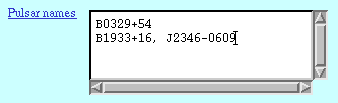
would produce a table including only the pulsars B0329+54, B1933+16 and J2346-0609. The pulsar names can be separated by a new line, comma, tab character or spaces. It is advisable to include the 'B' or 'J' in front of the pulsar name; if not both the pulsar B1950 and J2000 names will be searched for a match to the entered name. The name may include the wildcard characters '*' and '?'. For example, b1933+1? will match PSRs B1933+16, B1933+17 and B1933+15 whereas j004*+* will match PSRs J0040+5716 and J0048+3412.
2.5 Selecting pulsars within a boundary
It is also possible to select pulsars that lie within a certain region of the sky. Such a 'search' radius can be defined as a pulsar position (pulsar name), in equatorial coordinates (hh:mm:ss.ss, deg:mm:ss.ss or both in degrees) or in Galactic coordinates (degrees). The search radius around this coordinate is specified is specified in degrees. The Haversine formula (see R. W. Sinnott, "Virtues of the Haversine", Sky and Telescope, vol. 68, no. 2, 1984, p159) used in determining the distance of the pulsar from the specified coordinate is accurate even at high latitudes. It is, however, limited when the given coordinate and a pulsar position are close to being antipodal. The following example defines the region of the sky to be included to be within one degree of right ascension 19:33 and declination 16:00
Equatorial coordinates can be entered using white spaces or colons,
for example "19:33:00" is treated in the same manner as "19 33 00", "19
33" and "19:33". It is sometimes necessary to know the angular distance
between each pulsar and the central coordinate. Selecting 'Show pulsar's
distance from centre of this region' will provide a new column in the tabular
output giving this angular distance in degrees.
2.6 Pulsar Ephemerides
The user may wish to obtain all (or a large amount of) the information stored for a few pulsars. This is possible, but not practical, using the standard table forms. It is, therefore, possible to type the names of the pulsars of interest in the 'Pulsar names' area and then to select "Get Ephemeris". Three output formats are available. Short format provides all the pulsar parameters stored in the catalogue that are understood by the TEMPO [external link] pulsar timing package (most of the observed astrometric and rotational parameters, but no derived parameters). Long format provides all the information obtainable from the data stored in the catalogue (all observed, survey and derived parameters) and the Selected format uses the parameter selections made in the 'predefined variables' section to define which parameters to display. Examples are shown below.| Short format
JNAME
J1935+1616
|
Long format
JNAME
J1935+1616
|
2.7 Output
Two different types of output are available: a tabular form and a graphical display. These are described in the following two sections.2.7.1 Tabular Output
The final table can take seven different forms: 'short without errors', 'short csv without errors', 'short with errors', 'long with last digit errors', 'long with errors', 'long csv with errors' or 'publication quality', with 'long with last digit errors' as default. The short form is used to provide a condensed summary of the pulsar parameters; periods are given to six decimal places, dispersion measures to two decimal places etc. It is expected that this format will be used for producing tables that can be entered directly into, for instance, plotting packages where the full measured precision is not required. The short csv without errors gives the same data in csv format, with the separation character being a semicolon. The short format with errors provides uncertainties on the parameters that have corresponding errors. The actual value of the parameter is given to the same number of decimal places as the "short" format. The uncertainty is given in an exponent format to one decimal place. The long formats provides the parameters to their measured precision, their uncertainties and references. From the web interface it is possible to click on a reference label to obtain the full bibliographic reference (see Section 5). The uncertainty is given as an integer corresponding to the uncertainty in the last significant figure in the value. For example, "1.2 2" can be written as "1.2 +/- 0.2". The 'publication quality' format gives the parameters to full precision with corresponding uncertainties given in parenthesis. For example, 3.4(5) could also have been written as 3.4 +/- 0.5. The bibliographic references are included as a separate column on the right hand side of the table. The example below shows the table produced with the different output formats for the three pulsars with periods less than two milliseconds:| short: |  |
| short with errors: |  |
| long with last digit errors: |  |
| publication: |  |
Selecting 'No header' will produce a table with no header information at the top and with no spaces between groups of five pulsars. If a parameter has been selected, but does not exist in the catalogue (for example, not all pulsars have had their proper motions measured) then the table will contain a 'null value'. By default, this null value is set to a '*'. However, the user may enter any string into the Null Value text box to modify this output. For example, the user could enter: "-999.999" or "no value".
Tabular output may be copied to a local disk using the browser 'Save
As' function with Text format. Netscape provides a method of bypassing
the screen display: pressing Shift and the Table button together will copy
the output directly to the local disk. Alternatively, Select, Copy and
Paste functions may be used. Graphical output may be copied to a local
disk using a screen capture program such as xv.
2.7.2 Graphical Output
It is possible to display functions of the pulsar parameters as a graph. For a normal (x-y) graph, the values to plot are defined as regular expressions (see examples in Section 3) and the axes of the graph can be displayed linearly or logarithmically. The expressions may contain custom-defined variables. In the following example the user is plotting rotational periods against period derivatives on a logarithmic scale,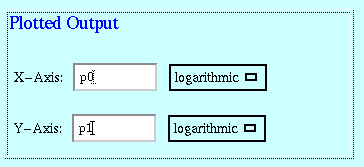
which gives the following output (after clicking on
 at the bottom, right of the main page):
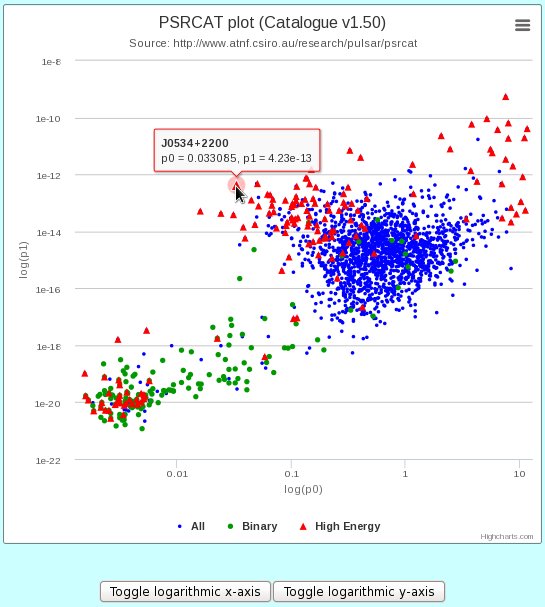
Binary pulsars are indicated in green, high energy pulsars in red and the remainder in blue. It is possible to zoom in by left-clicking and dragging the cursor to select a region. Plots can be downloaded by clicking on the menu at top right of the plot window.
2.8 A Few Examples
To produce a list of the names and Galactic coordinates of all the known pulsars with periods greater than two seconds and distances greater than 3 kpc:- Click on the box to the left of 'Name', 'GL' and 'GB' under the 'Predefined Variables' heading at the top of the web interface
- In the 'Condition' box, type: p0 > 2 && dist > 3
-
Move to the bottom of the page and click on

- Move to the bottom of the web interface and enter 'p0' in the 'X-Axis' box underneath the heading 'Plotted Output'. Change 'linear' to 'log' to plot the graph with logarithmic axes.
- Enter 'p1' in the 'Y-Axis' box and change 'linear' to 'log'.
-
Click on .
- Under the 'Predefined Variables' heading, select 'Name', 'RAJ', 'DECJ' and 'S400'.
- In the 'Condition' box type: decjd > -30 && exist(s400)
Click on the
icon at the bottom of the page.3. Valid Expressions
The evaluate [external link] libraries have been implemented and updated to allow the user to define new variables that are functions of the pulsar parameters (custom variables), to form logical expressions to define the pulsar sample and to define parameters for plotting. The expressions can contain the following operators:| + | Addition |
| - | Subtraction |
| * | Multiplication |
| / | Division |
| ** | Raise to the power |
| = | assignment |
| acos | inverse cosine | sin | sine of angle in radians |
| asin | inverse sine | sind | sine of angle in degrees |
| atan | inverse tangent | sinh | hyperbolic sine |
| atan2 | inverse tangent | sqr | square |
| cos | cosine of angle in radians | sqrt | square root |
| cosd | cosine of angle in degrees | tan | tan of angle in radians |
| cosh | hyperbolic cosine | tand | tan of angle in degrees |
| exp | exponential | tanh | hyperbolic tangent |
| ln | log (base 2) | fabs | absolute value |
| log | log (base 10) | fmod | modulus (two arguments) |
| log10 | log(base 10) |
Each function (except fmod) takes only one variable or expression which
should be typed immediately after the function name and enclosed in parentheses.
4. The Surveys
The table below lists the major pulsar surveys. The category 'misc' lists pulsars discovered in other (more limited) searches.|
|
|
Reference Keys |
|
|
| ar1 | Arecibo Survey 1 | ht74,ht75a,ht75b | 49 | 40 |
| ar2 | Arecibo Survey 2 | bkh+82,srs+86,sstd86 | 24 | 6 |
| ar3 | Arecibo Survey 3 | fst88,nft93,nft95 | 118 | 72 |
| ar4 | Arecibo Survey 4 | wol90a,wol91a,cnt93,fwc93,ntf93,tdk+93,cam95a,fcwa95,
wol95,cnt96,cnst96,rtj+96,zcwl96,snt97,mca00,cha03, clm+04,lwf+04,clm+05,lxf+05,lmcs07,bfrs18 |
141 | 94 |
| palfa | Arecibo Multibeam Survey | cfl+06,lsf+06,crl+08,hng+08,dcm+09,kac+10,kla+11,dfc+12,
csl+12,nab+13,skl+15,kls+15,lbh+15,pab+18,pkr+19,palfa21 |
310 | 176 |
| ar327 | Arecibo 327 MHz Drift-Scan Survey | dsm+13,dsm+16,msf+17,mgf+19,ar_drift21 | 57 | 48 |
| fast_uwb1 | FAST UWB | |||
| FermiBlind | Fermi Gamma-ray Observatory blind survey | aaa+09c,sdz+10,sbd+11,rkp+11,awd+12,pga+12,pga+12a,pgf+12,
pga+13,saa+23 |
83 | 53 |
| FermiAssoc | Searches of unidentified Fermi gamma-ray sources | rrc+11,kjr+11,hrm+11,ckr+12,gfc+12,kcj+12,bgc+13,pc15,
cck+16,san16,bph+17a,frm+18,wlz+18,plca18,nie+20,brj+21, trr+21,saa+23 |
136 | 104 |
| gb1 | Green Bank Northern Hemisphere survey | cls68,cp68,sr68,htg+68,lan69,fss73,dth78,dbtb82 | 50 | 31 |
| gb2 | Princeton-NRAO survey | dtws85 | 82 | 34 |
| gb3 | Green Bank short-period survey | stwd85 | 159 | 20 |
| gb4 | Green Bank fast pulsar survey | nst96,snt97 | 83 | 5 |
| gbt350 | Green Bank 350 MHz drift-scan survey | hrk+08,blr+13,lbr+13,rsm+13,rsa+14,kkl+15,srm+15 | 75 | 71 |
| gbncc | Green Bank North Celestial Cap survey | slr+14,kkl+15,kmk+18,acd+19,mss+20,amm+21 | 536 | 160 |
| ghrss | GMRT High Resolution Southern Sky Survey | bcm+15,brs+16 | 36 | 13 |
| htru_eff | High time resolution survey - Effelsberg | bck+13,bcf+17 | 17 | 14 |
| htru_pks | High time resolution survey - Parkes | kjv+10,lbb+10,kea10,kle+10,bbk+11,bbb+11a,kjb+12,bbb+12,
bbb+13,nbb+14,ncb+15,btb+15,cck+18,sbb+18,mbc+19,bsb+19, ccb+20 |
1147 | 242 |
| jb1 | Jodrell A survey | dl70,dlp70,dls72,dls73 | 51 | 37 |
| jb2 | Jodrell B survey | cl86,cjlm87,clj+92 | 62 | 42 |
| mol1 | 1st Molonglo survey | lvm68,lvw68,tv68,vlw69,wvl69,lvw69a,lvw69b,vl70,vl72 | 34 | 31 |
| mol2 | 2nd Molonglo Survey | mlt+78 | 224 | 154 |
| pks1 | Parkes 20-cm survey | jlm+92 | 100 | 46 |
| pks70 | Parkes Southern Sky survey | jlh+93,bhl+94,tnj+94,lnl+95,llb+96,mld+96,sbl+96,bjb+97,lml+98 | 298 | 101 |
| pkshl | Parkes high-latitude multibeam pulsar survey | bdp+03,lbk+04,bjd+06 | 41 | 18 |
| pksgc | Parkes globular cluster survey | mld+90,mlr+91,rlm+95,clf+00,dlm+01,rgh+01,dpf+02,pdm+03,
fre08 |
32 | 32 |
| pksmb | Parkes multibeam pulsar survey | ckl+00,klm+00a,lcm+00,mlc+01,cbm+01,clm+01,dkm+01,sml+01,
mhl+02,kbm+03,msk+03,fau04,hfs+04,fsk+04,sfl+05,lfl+06, mll+06,kel+09,kkl+09,ekl09,emk+10,kle+10,kkl+11,mlb+12, kek+13,eklk13,cbmp17 |
1124 | 834 |
| pkssw | Parkes-Swinburne multibeam survey | eb01,eb01a,ebvb01,jbv+03,jac05,jbo+07,jbo+09,bb10 | 244 | 109 |
| pkspa | Parkes Perseus Arm multibeam survey | bkl+13 | 15 | 14 |
| pksngp | Parkes deep northern Galactic Plane survey | lcm13 | 18 | 16 |
| pks_superb | Parkes survey for pulsars and extragalactic radio bursts | kbj+17,sfj+20,mke+20 | 29 | 29 |
| lotaas | LOFAR Tied Array All-sky Survey | tbc+18,mhl+18,scb+19 | 369 | 53 |
| fast_crafts | FAST Drift Scan Surveys | qpl+19,zlh+19,clh+20,prl+20,pmq+21,pqm+21,ypr+21,ccl+21,mzl+23 | 63 | 60 |
| fast_gpps | FAST GPPS Survey | hww+21,zhx+23 | 337 | 278 |
| chime | CHIME Pulsar Survey | gac+20,gac+21,dcm+23 | 28 | 28 |
| meerkat_trapum | MeerKAT TRAPUM survey | cro20,rgf+21,rfg+22,dpr+22.bbc+22,cbb+23 | 37 | 37 |
| tulipp | LOFAR Targetted Search for Polarized Pulsars | sbo+22 | 7 | 2 |
| mwa_smart | MWA SMART pulsar survey | sbs+21,mbs+22 | 2 | 1 |
| pumps | Puschino Muktibeam Pulsar Survey | tkt22 | 11 | 10 |
| misc | - | 389 | 398 | |
| mmgps-l | Shallow L-band MPIfR MeerKAT Galactic Plane survey |
5. References
References are given for all observed parameters in 'long' and 'publication' output formats , including the pulsar discovery (associated with the pulsar Name). In tables, a bibliographic key is given with each observed parameter. Clicking on this key will bring up the full bibliographic details for that reference.6. Distances
The pulsar distance (Dist) is a derived parameter as it depends on other catalogue parameters and is not itself a catalogue entry. The default value is that derived from the dispersion measure (DM) using the YMW16 model (Yao, Manchester & Wang, 2017) for the Galactic distribution of free electrons, i.e., Dist = Dist_DM. However, various other estimates can take precedence. First precedence is given to an independent distance estimate, Dist_A, based on an association with another object (e.g., globular cluster, supernova remnant, Large or Small Magellanic Cloud), measurements of absorption by neutral hydrogen combined with a model for differential rotation of the Galaxy or another estimate believed to be more reliable than the DM-derived distance. Next in priority order is a measured annual parallax (PX) with a value greater than three times the quoted uncertainty: Dist = 1/PX. If there are only distance limits, Dist_AMN and Dist_AMX, then Dist is set equal to the DM-derived distance if it lies between these limits or to the nearest limit if it doesn't. Dist_A and the limits Dist_AMN and Dist_AMX are available in Expert mode. Dist_DM1, a distance estimate based on the NE2001 Galactic electron-density model (Cordes & Lazio 2002) and the associated Dist1 (taking into account the above precedences) are also available in Expert mode.The Galactocentric coordinate system (XX, YY, ZZ) is right-handed
with the Sun at (0.0, 8.5 kpc, 0.0) and the ZZ axis directed toward
the north Galactic pole.
7. Feedback
Any comments, suggestions or criticisms can be submitted using a feedback form on the web interface here. The 'Name' and 'Email' boxes are not compulsory, but should be included if you require a reply to your comment.8. Upgrading the Catalogue
The catalogue database will be upgraded both in response to user feedback and to include data from recent publications.
9. Downloading the Catalogue
The current catalogue database and the PSRCAT source code may be downloaded by clicking on the "Download" link at the top of the Catalogue webpage.
PSRCAT is free software: you can redistribute it and/or modify it under the terms of the GNU General Public License as published by the Free Software Foundation, either version 3 of the License, or (at your option) any later version. PSRCAT is distributed in the hope that it will be useful, but WITHOUT ANY WARRANTY; without even the implied warranty of MERCHANTABILITY or FITNESS FOR A PARTICULAR PURPOSE. See the GNU General Public License for more details.
PSRCAT makes use of "evaluateExpression: A Simple Expression Evaluator".
Copyright (c) 1996 - 1999 Parsifal Software, All Rights Reserved.
Acknowledgements
Many people have contributed to the maintenance and upgrading of the database used for the Taylor, Manchester & Lyne (1993) paper. We particularly thank Andrew Lyne of the University of Manchester, Jodrell Bank Observatory, David Nice of Princeton University and Russell Edwards, then at Swinburne University of Technology. We also acknowledge the efforts of Warwick University students Adam Goode and Steven Thomas who compiled and checked a recent version of the database.The web interface was designed and constructed by Albert Teoh, during his tenure as a Summer Vacation Scholar at the ATNF, 2002/2003.
This work has made extensive use of NASA's Astrophysics Data System and the Google search engine. The plot facility makes use of the Highcharts plotting package.
The original database was compiled with the invaluable assistance of Maryam Hobbs during her term as a Research Assistant in the ATNF Parkes Pulsar Timing Array (PPTA) group (10/2003 - 4/2005). Since then this work has been continued by Diana Londish (8/2005 - 10/2006), Lucyna Kedziora-Chudczer (11/2006 - 6/2009), Ankur Chaudhary (9/2009 - 9/2012) and Lawrence Toomey (12/2012 - present).
We thank W. Becker for a pre-publication copy of "X-ray Emission from Pulsars and Neutron Stars", in "Neutron Stars and Pulsars", Astrophys. Space Sci. Library 357 (2008), Thomas Tauris and Paulo Freire for assistance with compiling the list of binary companion types and relevant references (see Tauris, Langer and Kramer, 2012, MNRAS, 425, 1601) and Meng Yu for updates to the glitch table. We acknowledge the use of Paulo Freire's website Pulsars in Globular Clusters and the McGill AXP/SGR Online Catalog which have provided valuable cross-checks and, in some cases, otherwise unpublished data. Finally, we thank our colleagues for their many comments and suggestions which have helped to improve both the database and the means of accessing it.
Appendix A: The Pulsar Parameters
Name:        Pulsar name.  The B name if exists, otherwise the J name.
JName:       Pulsar name based on J2000 coordinates
RAJ:         Right ascension (J2000) (hh:mm:ss.s)
DecJ:        Declination (J2000) (+dd:mm:ss)
PMRA:        Proper motion in the right ascension direction (mas/yr)
PMDec:       Proper motion in declination (mas/yr)
PX:          Annual parallax (mas)
PosEpoch:    Epoch of position, defaults to PEpoch (MJD)
ELong:       Ecliptic longitude (degrees)
ELat:        Ecliptic latitude (degrees)
PMElong:     Proper motion in the ecliptic longitude direction (mas/yr)
PMElat:      Proper motion in ecliptic latitude (mas/yr)
GL:          Galactic longitude (degrees)
GB:          Galactic latitude (degrees)
RAJD:        Right ascension (J2000) (degrees)
DecJD:       Declination (J2000) (degrees)
Timing solution and profile parameters:
P0:          Barycentric period of the pulsar (s)
P1:          Time derivative of barycentric period (dimensionless)
F0:          Barycentric rotation frequency (Hz)
F1:          Time derivative of barycentric rotation frequency (s-2)
F2:          Second time derivative of barycentric rotation frequency (s-3)
F3:          Third time derivative of barycentric rotation frequency (s-4)
PEpoch:      Epoch of period or frequency (MJD)
DM:          Dispersion measure (cm-3 pc)
DM1:         First time derivative of dispersion measure (cm-3 pc yr-1)
RM:          Rotation measure (rad m-2)
W50:         Width of pulse at 50% of peak (ms). Note, pulse widths are a function of both observing frequency and
             observational time resolution,so quoted widths are indicative only. Refer to the original reference for details.
W10:         Width of pulse at 10% (ms). Note the comments above for W50.
Units:       Timescale for period/frequency and epoch data: TCB or TDB.
             See Hobbs, Edwards & Manchester (2006) for a discussion of the relationship between TCB and TDB.
Tau_sc:      Temporal broadening of pulses at 1 GHz due to interstellar scattering (s).
             Note: values measured at other frequencies are scaled assuming Tau_sc ~ nu^{-4.4}.
S400:        Mean flux density at 400 MHz (mJy)
S1400:       Mean flux density at 1400 MHz (mJy)
S2000:       Mean flux density at 2000 MHz (mJy)
Binary system parameters:
Binary:      Binary model (usually one of several recognised by the pulsar timing programs TEMPO or TEMPO2).
             Modified versions of standard models are often used - refer to the source paper for details of the binary model used.
T0:          Epoch of periastron (MJD)
PB:          Binary period of pulsar (days)
A1:          Projected semi-major axis of orbit (lt s)
OM:          Longitude of periastron (degrees)
ECC:         Eccentricity
TASC:        Epoch of ascending node(MJD) - ELL1 binary model
EPS1:        ECC x sin(OM) - ELL1 binary model
EPS2:        ECC x cos(OM) - ELL1 binary model
MinMass:     Minimum companion mass assuming i=90 degrees and neutron star mass is 1.35 Mo
MedMass:     Median companion mass assuming i=60 degrees
BinComp:     Companion type
Distance parameters:
Dist:        Best estimate of the pulsar distance using the YMW16 DM-based distance as default (kpc)
Dist_DM:     Distance based on the YMW16 electron density model.
             In 'LONG' or 'PUBLICATION QUALITY' modes, lower limits from the distance model are preceded by a '+' sign.
DMsinb:      DM x sin(b) (cm-3 pc)
ZZ:          Distance from the Galactic plane, based on Dist
XX:          X-Distance in X-Y-Z Galactic coordinate system (kpc)
YY:          Y-Distance in X-Y-Z Galactic coordinate system (kpc)
Associations and survey parameters:
Assoc:       Names of other objects, e.g., supernova remnant, globular cluster or gamma-ray source
             associated with the pulsar
Survey:      Surveys that detected the pulsar (discovery survey first). Click here for currently defined surveys.
OSurvey:     Surveys that detected the pulsar encoded as bits in integer
Date:        Date of discovery publication.
Type:        Type codes for the pulsar. Click here for available types.
NGlt:        Number of glitches observed for the pulsar
Derived parameters:
R_Lum: Radio luminosity at 400 MHz (mJy kpc2) R_Lum14: Radio luminosity at 1400 MHz (mJy kpc2) Age: Spin down age (yr) [] BSurf: Surface magnetic flux density (Gauss) [
] Edot: Spin down energy loss rate (ergs/s) Edotd2: Energy flux at the Sun (ergs/kpc2/s) PMTot: Total proper motion (mas/yr) VTrans: Transverse velocity - based on DIST (km/s) P1_i: Period derivative corrected for Shklovskii (proper motion) effect Age_i: Spin down age from P1_i (yr) BSurf_i: Surface magnetic dipole from P1_i (gauss) B_LC: Magnetic field at light cylinder
Appendix B: Pulsar Types
| AXP | Anomalous X-ray Pulsar or Soft Gamma-ray Repeater with detected pulsations |
| BINARY | Pulsar has one or more stellar companion(s) |
| HE | Spin-powered pulsar with pulsed emission from radio to infrared or higher frequencies |
| NRAD | Spin-powered pulsar with pulsed emission only at infrared or higher frequencies |
| RADIO | Pulsars with pulsed emission in the radio band |
| RRAT | Pulsars with intermittently pulsed radio emission |
| XINS | Isolated neutron stars with pulsed thermal X-ray emission but no detectable radio emission |
Appendix C: Binary Companion Types
| MS | Main-sequence star |
| NS | Neutron star |
| CO | CO or ONeMg White Dwarf |
| He | Helium White Dwarf |
| UL | Ultra-light companion or planet (mass < 0.08 solar masses) |