

Speakers and attendees of the 2026 Radio School
The ATNF Radio School 2026 is an immersive training program designed for PhD students, postdoctoral researchers and early career astronomers who want to build solid foundations in radio interferometry and hands-on data skills. Hosted by CSIRO’s Australia Telescope National Facility (ATNF) at the Paul Wild Observatory on Gomeroi Country, near Narrabri, NSW, this year’s school blends core theory with practical calibration and imaging tutorials at one of Australia’s premier radio astronomy facilities. The site is home to our Australia Telescope Compact Array (ATCA).
Over the course of the week, participants will learn the fundamentals of radio interferometry, antenna calibration, data flagging and imaging through a mix of expert-led lectures and interactive, practical sessions. Unique to 2026, the program will feature tutorials making use of ATCA’s new Broadband Integrated GPU Correlator (BIGCAT), the next-generation correlator system that significantly expands ATCA’s instantaneous bandwidth and data flexibility, giving attendees early experience with cutting-edge correlator operations and data pipelines.
The 2026 Radio School is aimed at PhD students and postdoctoral researchers in astronomy. The Radio School offers a supportive environment to engage deeply with real interferometric data, develop essential calibration and imaging workflows, and connect with leaders in the field. No prior experience with radio astronomy is required.
For those students who are unable to attend the Radio School in-person in Narrabri, a virtual option will be available for the lectures.
Key Dates:
Registration Opens: mid-February 2026
Registration Closes: 15 April 2026 (or once capacity has been reached)
Radio School: 1 – 5 June 2026
Registration
There is a registration fee for attendance at the Radio School. The registration fee for in-person attendance at the Radio School, covers all lunches, morning and afternoon teas, as well as organised social events events, but not accommodation and travel.
In-person registration is capped at 45 students and registration is only complete upon receipt of full payment of registration fees.
Once your registration form is received, you will be sent a secure, individual link to complete payment. Please note that this is not an automated process and the Organising Committee will endeavour to send out payment links as soon as possible.
Registration Fees:
- Registration has now closed
Cancellation policy:
- prior to 15 April – refund of full registration fees
- prior to 1 May – 50% refund of registration fees
- after 1 May – full registration fees will be forfeited
Program
The program for the 2026 Radio School is now available
Software and Data for Tutorials can be found here
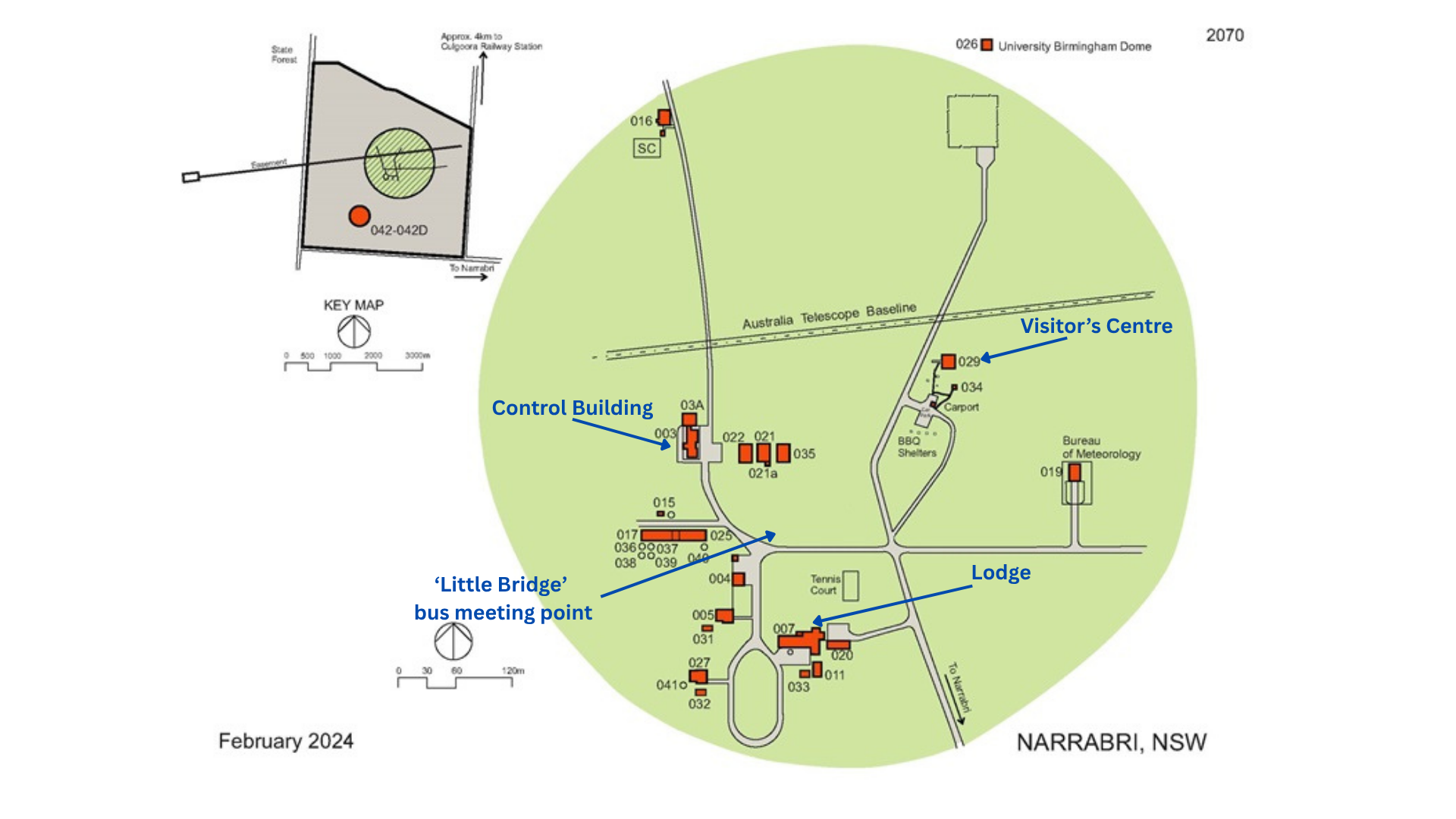
A map with the location of where lectures, tutorials and events will be held can be found here.
List of Speakers
- Christoph Brem (CSIRO)
- Jaiden Cook (CSIRO)
- Stefan Duchesne (CSIRO)
- Phil Edwards (CSIRO)
- Ron Ekers (CSIRO)
- Emmy Escott (CSIRO)
- Tim Galvin (CSIRO)
- Doug Hayman (CSIRO)
- Aidan Hotan (CSIRO)
- Jane Kaczmarek (SKAO)
- Junhan Kim (KAIST)
- Konstantinos Kolokythas (Rhodes University / SARAO)
- Elizabeth Mahony
- Liroy Lourenco (CSIRO)
- Vanessa Moss (CSIRO)
- Chris Phillips (CSIRO)
- Joshua Pritchard (CSIRO)
- Rachel Rayner (CSIRO)
- Cormac Reynolds (CSIRO)
- Kovi Rose (CSIRO / University of Sydney)
- Jamie Stevens (CSIRO)
- Tessa Vernstrom (CSIRO)
- Jennifer West (University of Tasmania)
- Ivy Wong (CSIRO)
Presentations
Presentations by the speakers of the 2026 Radio School can be found here.
Social Events
The Organising Committee will be organising some social events during the Radio School, the cost of which is included in your in-person registration fees. These activities include:
- Monday, 1 June – Dinner and Trivia at Narrabri RSL Club (walking distance from most accommodation in town)
- Wednesday, 3 June – Dinner and Star Party at the Paul Wild Observatory
- Friday, 5 June – BBQ on site and afternoon walk around Sawn Rocks (at the end of the Radio School, transport will be provided)
Student Travel Grants
The funding allocation for Student Travel Grants has now been exhausted.
For more information regarding Student Travel Grants, please contact amanda.gray_at_csiro.au.
Radio-Frequency Interference Protection
The Paul Wild Observatory is a ‘radio quiet’ zone to protect the radio astronomy site from noise created by modern life.
Please turn off any radio-emitting devices BEFORE entering the observatory gate on Yarrie Lake Road and ensure that you follow the instructions below to avoid radio frequency interference.
Don’t:
- Use your mobile phone at the observatory.
- Use Bluetooth connected laptops, mouses or keyboards at the observatory.
- Use cameras unless approved by the Site Manager. Cameras on smart devices can be used if they are in aeroplane mode.
Do:
- Turn off or place in aeroplane mode all mobile phones, iPads, smart watches or similar devices that have a cell/mobile phone connection while at the observatory.
- Turn off (or don’t bring to site at all) any personal fitness trackers or smart watches as they typically have Bluetooth and/or WiFi.
Organising Committee
SOC: Tessa Vernstrom (Chair), Christoph Brem, Jaiden Cook, Phil Edwards, Emmy Escott, Tim Galvin, Chris Phillips, Sanja Lazarevic, Elizabeth Mahony, Vanessa Moss, Kovi Rose, Sai Wagh
LOC: Amanda Gray, Jane Trindall, Leanne Edwards, Pam Kelly
If you have any questions about the Radio School, please contact Amanda Gray at amanda.gray_at_csiro.au.
Code of Conduct

Vivianne Smith, Yurruun the Mirii (track the stars), 2026. The six circles represent the Australia Telescope Compact Array that runs on tracks near Narrabri, at the Paul Wild Observatory on Gomeroi Country. The hands represent our ancestors and how they used the stars to navigate over Country, with the central circle represents the meeting places and sacred sites where they would gather. Using the night sky, our ancestors would study it and be shown season changes, when to hunt and gather, and be given help when walking across Country. Travelling was mostly done under the night sky and stories were told using the stars that have been passed down to each generation. Stories like the Emu in the Sky that would tell you when the emu was nesting, or the story of the Seven Sisters: a journey of seven sisters who escaped to the sky to become what is now known as the Pleiades star cluster.
Page last updated: 29/05/2026