
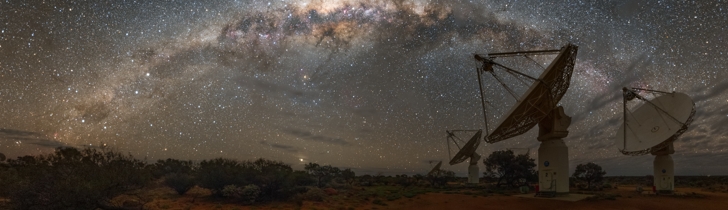
The ASKAP radio telescope
CSIRO's ASKAP radio telescope, is situated at the Inyarrimanha Ilgari Bundara, the CSIRO Murchison Radio-astronomy Observatory on Wajarri Yamaji Country in the Murchison region of Western Australia, about 800 km north of Perth. ASKAP uses novel technology to achieve extremely high survey speed, making it one of the best instruments in the world for mapping the sky at radio wavelengths.
ASKAP embarked on the full surveys for which it was designed in late 2022. This website describes the technology, science and history of ASKAP, as well as technical references for astronomers interested in using ASKAP data. A broader overview of ASKAP and the ATNF can be found on the main CSIRO website.
Be sure to follow @CSIRO_ATNF on Twitter for exciting astronomy content, including that from ASKAP.
Current users of the ASKAP telescope can head to the Confluence page for policies, guides and team information.
What is ASKAP?
ASKAP is a synthesis array consisting of 36 dish antennas, each 12m in diameter, spread out in two dimensions with baselines up to 6km. Each antenna is equipped with a phased array feed (PAF) that can be used to form 36 dual-polarisation primary beams, giving the telescope its wide field of view and rapid survey capability when coupled with high-speed digital processing systems and the HPC facilities at the Pawsey Supercomputing Research Centre in Perth.
A Rapid ASKAP Continuum Survey (RACS) was commissioned in 2020 to test this capability. Approximately three million galaxies across the entire southern sky were mapped in a record-breaking 300 hours. One million of them had never been seen before. You can read more, and take the interactive tour, on CSIRO’s dedicated RACS page.
Each PAF comprises 188 individual receiving elements which are sensitive to radio waves with frequencies in the range 700 - 1,800 MHz. The feeds are mounted at the prime focus of each 12m antenna, yielding about a 30 square degree field of view per dish, some 30 times larger than possible with a traditional receiver.
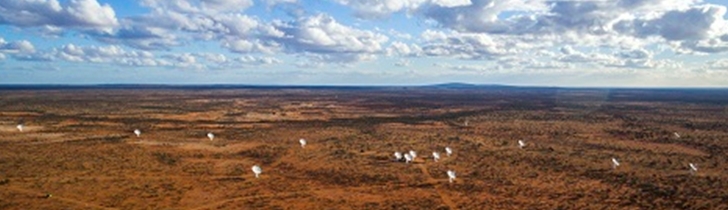
Why is ASKAP in Western Australia?
ASKAP is located at the Inyarrimanha Ilgari Bundara, the CSIRO Murchison Radio-astronomy Observatory (site), approximately 315km northeast of Geraldton.
The site is ideal for radio astronomy as it exhibits excellent sky coverage, superb radio quietness, ionospheric stability and benign tropospheric conditions. The extremely low levels of radio-frequency interference will allow highly sensitive instruments such as ASKAP to conduct ground-breaking astronomy research.
This area makes up the Australian Radio Quiet Zone WA (ARQZWA), which was established to shield radio astronomy receivers from harmful interference. The ARQZWA is protected by the legislation, regulatory and policy instruments put in place by the Australian Communications and Media Authority and three protected zones managed by the Department of Mines and Petroleum in the WA government.
What is ASKAP up to?
ASKAP has commenced its five-year survey program for six of nine international survey projects that address goals relating to understanding galaxy evolution, transient sources, polarisation, and magnetism, among others. Two more are in the final stages of preparation and another assessing technical requirements based on emerging capabilities. This is a historic milestone for ASKAP, which has been preparing for survey operations through science commissioning, an early science observing campaign, two rounds of pilot surveys and four surveys of the entire observable sky as part of the Rapid ASKAP Continuum Survey over the past few years.
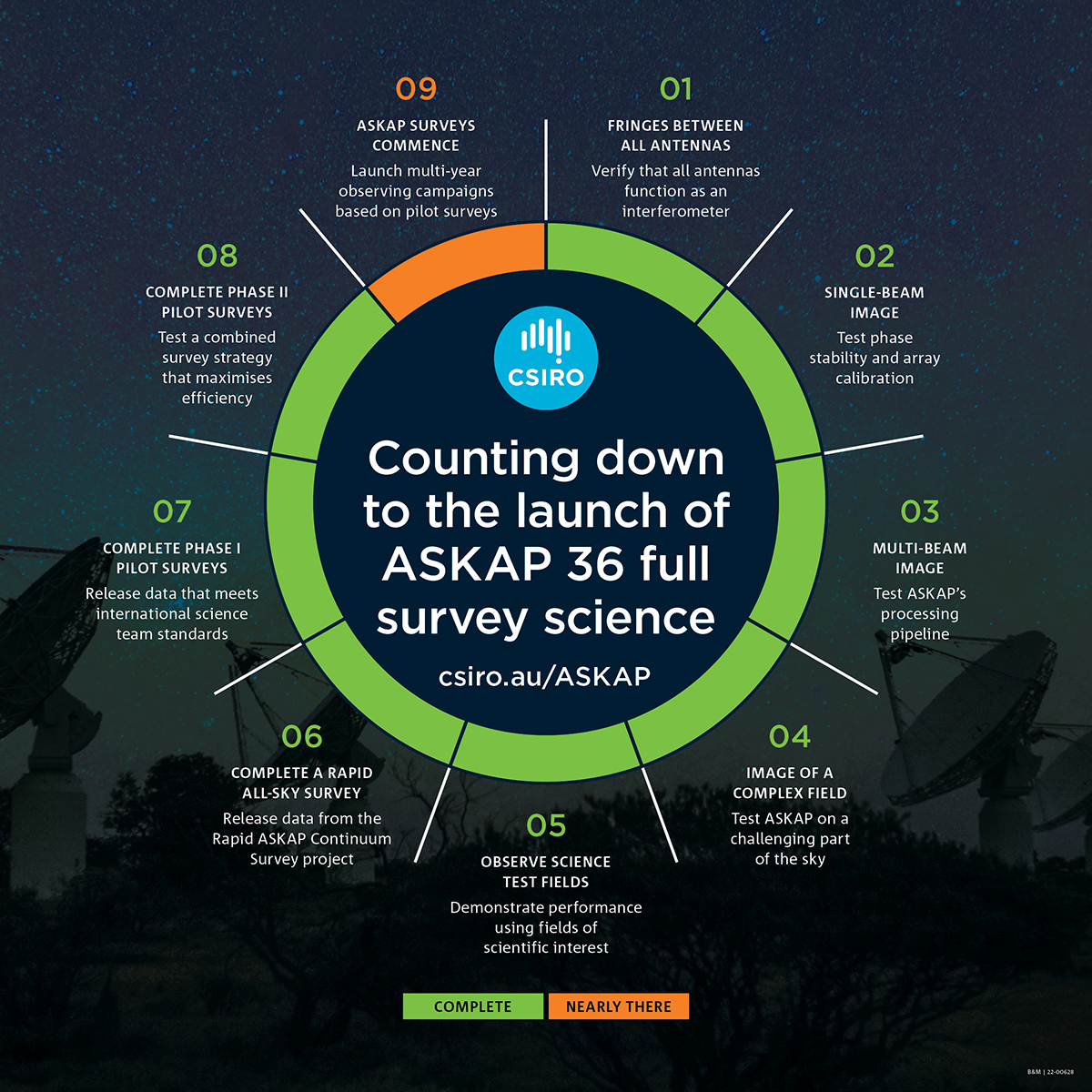
These are all part of the initial phase for ASKAP, as the new and innovative technology is put to the test. Each step in this process is captured in our Countdown Clock, as we aim for full operational mode:
ASKAP’s capabilities represent a big leap forward, so the surveys we are conducting have already made unexpected discoveries: about a million of the galaxies seen by RACS had never been observed before. Some other ground-breaking discoveries and technological innovations are:
• Fast radio bursts (FRBs)
• Odd radio circles (ORCs)
• Intergalactic dust trails
• Phased array feeds (PAFs)
To read more about the science research taking place at ASKAP, visit our Science page. More about the technologies involved in ASKAP is on our Technology page. A list of publications about ASKAP and its observations is available on the Publications page.
For more information
Media: Rachel Rayner, Senior Communications Advisor
Science: Aidan Hotan, ASKAP Project Scientist
ASKAP is an SKA-precursor telescope situated on Inyarrimanha Ilgari Bundara, the CSIRO Murchison Radio-astronomy Observatory in Western Australia.
We acknowledge the Wajarri Yamaji People as the Traditional Owners and native title holders of the Observatory site.