
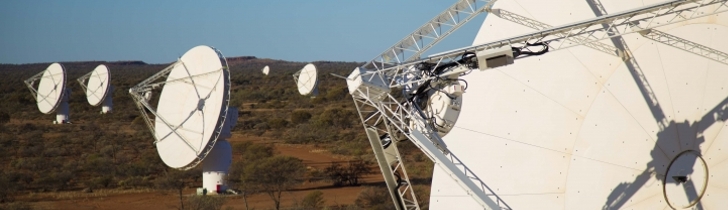
ASKAP Technologies
ASKAP is designed to be a high speed survey instrument with high dynamic range. This requires an extremely wide field-of-view interferometer with Phased Array Feeds (PAFs) consisting of 188 elements, with 96 in each of two polarisations as the focal plane detectors.
The specification for ASKAP is:
- A total collecting area of approximately 4,000 square metres, from 36 antennas each 12 metres in diameter
- System temperature less than 50 K
- Frequency range from 700 MHz to 1.8 GHz
- 300 MHz instantaneous bandwidth
- 36 independent beams, each of about 1 square degree, yield overlapping to a 30 square degree field-of-view at 1.4 GHz
- Maximum baseline of approximately 6 km
- Full cross-correlation of all antennas
- Possible remote array station capability located in NSW, approximately 3,000 km from the core site.
Technological Goals
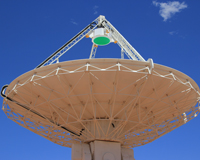
To achieve the ASKAP specification, the project's technological goals are to develop:
- 10x10 dual polarisation receivers operating over the frequency range 700 MHz to 1.8 GHz, one in each of 30 parabolic reflector antennas
- Radio Frequency Interference (RFI) and spectral line ripple cancellation using the receiver response
- RF and IF beam-forming to give extremely wide fields of view
- High polarisation purity
- Correlation of large number (in the order of order 30) independent beams
- Wide band operation with low RFI levels
- Proof of infrastructure in remote desert environment (power supply, on site data transport)
- Cooling of the instrument's phased array feeds
- e-VLBI capability over a 3,000 km baseline.
Opportunities for Industry
Information on opportunities for industry to be involved in the development of ASKAP can be found on the industry page.
Further Information
- Information on ASKAP's antennas
- Information on ASKAP's receivers
- Information on ASKAP's smart feeds
- Information on ASKAP's digital systems
- Information on ASKAP's data transport and signal transmission systems
- Information on ASKAP's computing architecture
- Information on the Parkes Testbed Facility
- Latest ASKAP Technical Update newsletter
ASKAP
Access:
Public