ATNF Science Highlights 2004
A wind bubble around a magnetar
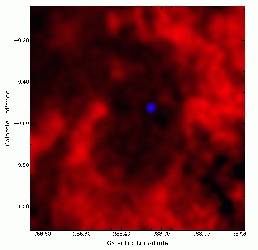
Magnetar are pulsars with extremely high surface magnetic fields, however, the difference of their origin is not understood. Data from the Southern Galactic Plane Survey shows a cavity in the interstellar medium around the magnetar 1E 1048.1-5937. These cavities are common around massive stars which blow material away from their surfaces, but in the case of 1E 1048.1-5937, no nearby star massive enough to form such a bubble could be found. This suggests that the bubble was formed by the stellar progenitor of the magnetar, and that the supernova occurred quite recently. It also suggests that the difference between the origin of normal neutron stars and magnetars is related to the progenitor's mass. From the known distribution of stellar masses then follows that magnetars form at a rate which is 10 times lower than that of normal pulsars. read more
|
 |
Discovery of pulsed OH maser emission stimulated by a pulsar
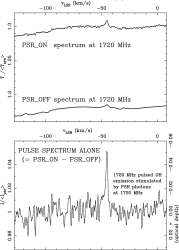
Pulsars are useful objects to study the interstellar medium (ISM). Using the Parkes telescope, ATNF astronomers have discovered pulsed OH maser emission in the direction of the pulsar PSR B1641-45. The study unambiguously shows how the OH emission varies with the pulsar emission, and is the first that provides direct evidence for stimulated amplification of a signal in the ISM. As the pulsar emission varies within a few milliseconds, it is also the quickest maser variation yet detected. The shape of the maser emission lines allows more conclusions to be drawn about the geometry of the OH clouds between the pulsar and us observers. When a pulse passes through the clouds (on-spectrum), the lines are narrow, while they are broad between the pulses (off-spectrum). The line of sight to the pulsar, which is probed in the on-spectra, is very narrow, and may be significantly different from the surrounding medium. In the off-spectra, however, the entire cloud is probed, and an average over a larger region is made. read more
|
 |
A "new" spiral arm for the Milky Way?
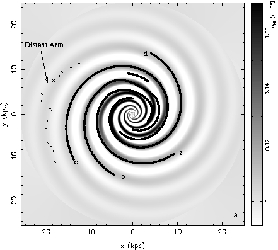
The shape and structure of the Milky way, especially the distribution of its neutral hydrogen (HI), is not well known. The recently completed Southern Galactic Plane Survey (SGPS) has mapped the HI in our galaxy using the Parkes telescope and the Compact Array, and the data show an extended structure in the far outer galaxy. The velocity of HI can be used to identify the location of HI, and the new feature was determined to be between 17 kpc and 25 kpc away, and to have a height over the galactic disk of between 1.2 kpc and 1.7 kpc. The location of the feature indicates that it may be a spiral arm, and model calculations can reproduce structures very similar to the one observed. Other interpretations like elliptical gas orbits or a very smooth extended HI disk were found to be inconsistent with the data. The measurements may even show the gravitational effect of the Magellanic Clouds on the Milky Way. read more
|
 |
The Galactic All-Sky Survey (GASS)
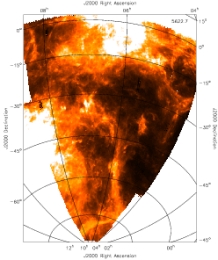
Galactic neutral hydrogen (HI) is observed in all directions of the sky. Whilst the large-scale structure of HI has been mapped in detail, the finer structures have yet mostly been ignored. The Galactic All-Sky Survey (GASS) uses the Parkes multibeam receiver to image the HI south of declination 0° with an angular resolution of 15 arcminutes, a velocity resolution of 1 km/s and a sensitivity limit of 70 mK. GASS will focus on the galactic halo and its interaction with the disk. Recent studies show that the halo contains plenty of small, cold HI clouds, the origin of which is unknown. GASS will also shed light on high velocity clouds (HVCs). These clouds orbit the Galaxy with high velocities inconsistent with galactic rotation. They may be tidal debris, related to a galactic fountain, and dark matter halos. GASS will be a sensitive, high-resolution, unbiased survey, and will use more than 1500 hours of telescope time, and the first results look spectacular. read more
|
 |
The Delta Quadrant Survey
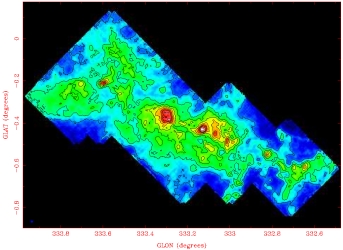
Star formation has long been a riddle, but recent models suggest that turbulence on a wide range of spatial scales is able to create and regulate star formation. To provide the models with observational constraints, ATNF astronomers use the Mopra telescope to map the 13CO (J=1-0) transition in the giant molecular cloud RCW 106, located in the fourth quadrant (hence "Delta Quadrant") of the Milky Way. The project required the development of On-the-Fly mapping, which allows to continuously scan across the sky without the need for discrete telescope pointings. The data will be analysed to characterise the turbulence in detail, and will be supplemented with observations of the C18O line and with data from the SPITZER space telescope. This will yield a picture of the relationship between turbulence and star formation across a region roughly 100 pc in size. read more
|
 |
How to feed a starburst
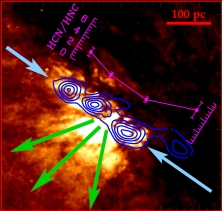
Star formation is believed to happen when sufficiently cool gas collapses under its own gravitational force, and the core becomes dense enough for nuclear reactions. In some galaxies, dubbed "starburst galaxies", the rate at which this process happens is much higher than in our Galaxy, and the regions are much smaller. Molecules are an excellent tracer of this process, and are now observable with the Compact Array, and one very prominent starburst galaxy is NGC253, which has been observed with the new 3 mm receivers to find emission from HCN and HNC. The ratio of the emission from these molecules gives insight to the environmental conditions where they are formed, with a high HCN/HNC ratio indicating higher temperatures through conversion of HNC to HCN. However, towards the centre in NGC 253, where most stars are formed, the ratio unexpectedly decreases. This can be understood as a self-shielding process which keeps the molecular gas cool and allows it to further collapse and form new stars. read more
|
 |
Highly-redshifted CO in galaxies
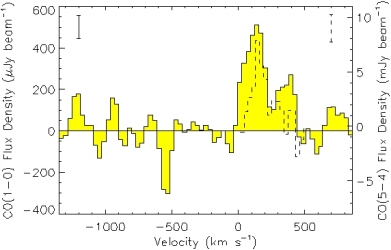
With the new 12 mm and 3 mm receivers coming into operation on the Compact Array, new possibilities for the study of molecules such as carbon monoxide and molecular hydrogen at several redshifts have been created. Radio emission from galaxies a few billion years after the Big Bang can give clues about the formation of massive galaxies we still see today. The most distant radio galaxy known to date is TN J0924-2201, at a redshift of 5.2. Only the millimetre upgrade of the Compact Array made it possible in 2004 to observe carbon monoxide in this galaxy, with a total mass of about 100 billion solar masses. This discovery also places an upper limit of 1.1 billion years on the time scale for star formation in this galaxy. Furthermore, the galaxy is peculiar in that it does not have the amount of dust which would be expected from the amounts of molecular gas, indicating that many similar objects still remain to be found. read more
|
 |
|