
Millimetre Science With the Upgraded Australia TelescopeU. of Melbourne, 29-30 November 2001
list of participantsabstractspresentations
|
 |
Overview
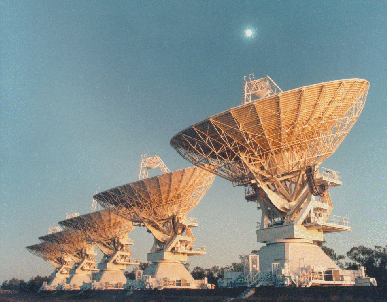
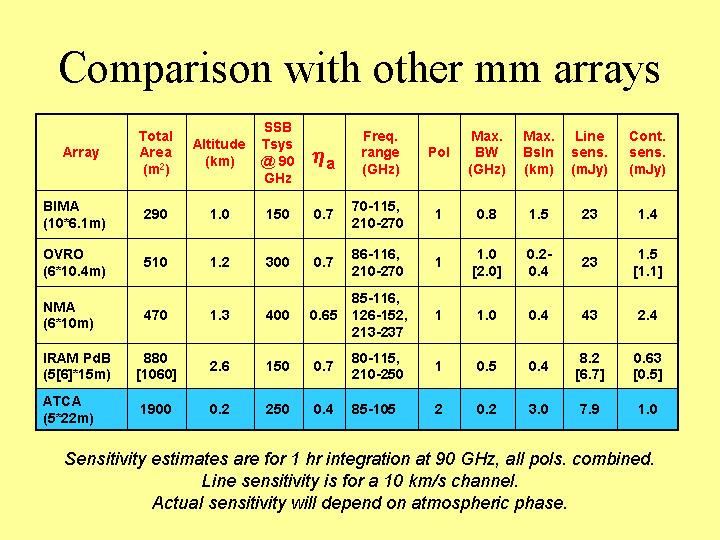
As part of an award from the Australian Government through the Major National Research Facilities (MNRF) Program, announced in 1995, the Australia Telescope National Facility (ATNF) has been upgrading the AT Compact Array for high-frequency operation at wavelengths of 12 mm and 3 mm. This upgrade will create a Southern Hemisphere millimetre interferometer with sensitivity, resolution, and flexibility rivaling that of the largest Northern Hemisphere arrays. With the first stage of the upgrade -- creation of a prototype 3-element system -- now complete, we are organising this workshop to share ideas on how best to exploit the mm-wave capabilities of ATCA, both in the near term and once the upgrade is complete. We hope that this workshop will also foster the growth of an active mm-wave community in Australia.
Goals
- To identify the major unsolved problems in astrophysics where mm observations with ATCA can have an impact.
- To publicize the capabilities of the upgraded ATCA at millimetre wavelengths to potential users.
- To encourage collaborations on proposals for the winter 2002 season.
Overseas Invited Speakers
- Geoff Blake, Caltech (USA)
- Tyler Bourke, Harvard-Smithsonian CfA (USA)
- Cornelia Lang, University of Massachusetts (USA)
- Georgij Rudnitskij, Sternberg Astronomical Institute (Russia)
- Andrej Sobolev, Ural State University (Russia)
- Tommy Wiklind, Onsala Space Observatory (Sweden)
Topical Sessions (Programme here)
- Capabilities of the ATCA
- Interstellar Matter
- Young Stellar Objects and Masers
- Extragalactic Studies
Information for Participants (Registration form here)
The workshop will begin Thursday morning around 10 a.m. (for those flying into Melbourne) and adjourn Friday afternoon. Included in the AU$50 registration fee (payable in cash at the meeting) will be lunch and refreshments both days. There will also be a workshop dinner Thursday night at the Stokehouse in St Kilda, which participants will pay for out of pocket. If you registered by Nov. 2, you will only pay $40 for registration. The registration fee has now increased to $50. The fee will be waived for students, but only if registered by Nov. 2.
The present exchange rate is about 50 US cents per AU dollar. Check here for other currencies.
Follow this link for directions to the workshop venue. The workshop will take place in the Elizabeth Murdoch Building (formerly Old Pathology Building) on the main campus of the University of Melbourne, within walking distance of the Melbourne CBD. Click here for an orientation map and follow the "Maps of Parkville Campus" link for a detailed campus map. There is also a useful public transport website.
Up-to-date information about things to do in Melbourne can be found at its citysearch site. See also these restaurant and sightseeing guides, courtesy of the Melbourne Uni graduate students.
Accommodation at St Mary's College (just across the road from Physics at U. Melb) is now fully booked. The rate (single occupancy only) is $45 for bed + breakfast; bathroom facilities are shared. Payment by MasterCard, Visa, or bankcard is acceptable.
For those wishing to stay at a hotel, an inexpensive (and convenient) choice is Hotel Ibis, about 5 minutes' walk from campus and about $110 per night. Ask for the reduced rate for U. of Melbourne visitors. Click here for info on this and other accommodation options.
If you wish to attend the workshop please complete the online registration form.
Contact numbers during the workshop:
School of Physics: +61 (0)3 8344 7670 (TEL); +61 (0)3 9347 4783 (FAX)
(leave a message for Andrew Melatos)
St Mary's College: +61 (0)3 9349 9505 (TEL); +61 (0)3 9349 1335 (FAX)
Scientific Organising Committee
- Andrew Melatos, U. of Melbourne
- Tony Wong, ATNF
- Bärbel Koribalski, ATNF
- Mark Wardle, U. of Sydney
- Ramesh Balasubramanyam, UNSW
Enquiries should be addressed to mmwkshp @ atnf.csiro.au.
Other meetings near this time
- IAU Symposium 209: Planetary Nebulae, Canberra, 19-23 November
- Next-Generation Astronomical Surveys, Sydney, 3-4 December
- ATNF Astrofest, Marsfield, 5 December
- Charlene Heisler AGN workshop, Canberra, 6-7 December
Page last updated 20 Nov 2001
Problems with these webpages should be addressed to Tony Wong (Tony.Wong @ csiro.au).