ATNF Science Highlights 2003
The first double pulsar
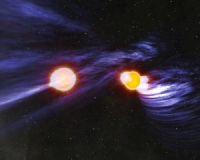
It has long been known that some pulsars exist in systems of two neutron stars orbiting each other, yet a direct observation of both stars in such a system has not existed until now. In late 2003, a team of pulsar astronomers discovered the first double pulsar using the Parkes radio telescope. The binary pulsar allows a number of important measurements to be made, e.g., the masses of the companions were determined to be 1.337+/-0.004 solar masses and 1.251+/-0.004 solar masses - an uncertainty of only 0.3%. Fortunately, the system happens to be seen almost exactly edge-on. This geometry allows a direct observation of the curvature of space-time as light from one pulsar passes near the other one and experiences relativistic effects. read more
|
 |
Temperature maps of dense molecular gas in starburst galaxies
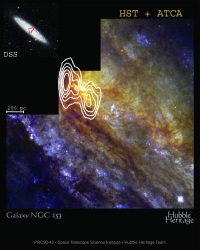
The new 12 mm receiver system installed at the Compact Array in April 2003 for the first time allows southern-hemisphere astronomers to observe important spectral lines of ammonia. Ammonia is an excellent "thermometer", and observations of two 12 mm transitions of this molecule allowed the mapping of the temperature of the cold, molecular gas in the nearby star-burst galaxy NGC 253. Four dense molecular complexes were identified near the galaxy's starburst core but, surprisingly, the complexes which lie closest to the star forming activity are the coolest. This suggests that neither the weak AGN nor the starburst dominate the heating of molecules. The abundance of ammonia, however, decreases towards the centre of the star-forming activity as expected because the strong UV radiation dissociates the molecules. read more
|
 |
What and where are the High-Velocity Clouds (HVCs) around the Milky Way?
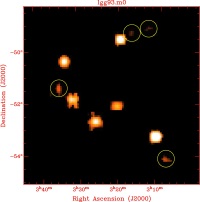
Clouds of neutral hydrogen (HI) moving at velocities too high for galactic rotation have been known to exist for more than 40 years. However, their lack of stars usually prevents accurate distance, and therefore mass determinations, and so their origin remains unclear. Using the Parkes telescope and the Compact Array, ATNF astronomers have searched for such HVCs in nearby groups of galaxies that are similar to the Milky Way's Local Group. They discovered ten new HI-rich dwarf galaxies, but identified each of them with an optical counterpart, meaning that, unlike HVCs, they contain stars. Assuming HVCs in the observed galaxy groups have similar properties than those in the Local Group, their non-detection places an upper limit on their masses. They must have less than 400,000 solar masses and distances of less than 160,000 parsecs from the Milky Way. This finding has important consequences for theories of galaxy formation. read more
|
 |
Gamma-ray burst jets in type Ib/c supernovae
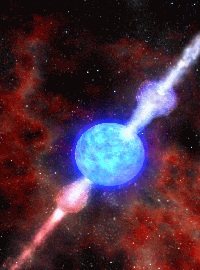
Gamma-ray bursts are the most energetic explosions in the universe, and their nature was entirely enigmatic until a few years ago. When astronomers observed the gamma-ray burst GRB 980425, they surprisingly discovered a type Ic Supernova, SN 1998bw, at the same coordinates, and only 40 million parsecs away - much closer than expected. However, the afterglow of GRB 980425 was much weaker than was observed in many other gamma-ray bursts. A possible explanation is that the jet collimation axis was pointing away from earth. As the jet decelerates, it is expected to expand and to spread sideways, resulting in increased radio emission. This increase has not yet been found, and so another theory postulates that GRB 980425 is a member of a subclass of gamma-ray bursts with underluminous afterglows. The discovery of the next closest gamma-ray burst, GRB 031203, with a similar underluminous afterglow, supports this explanation. read more
|
 |
HI tidal tails, bridges and clouds
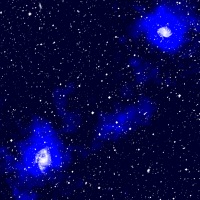
Neutral hydrogen (HI) is a major ingredient in most galaxies, but can occasionally be found well outside their stellar envelopes and between galaxies. This gas is stripped away from the parent galaxies by tidal forces, mergers, and interactions, and the HI may then form new dwarf galaxies. Observations of a sample of these peculiar HI objects with the Compact Array revealed a plume with a mass of 2x10⁹ solar masses stripped away from a peculiar spiral galaxy by a massive elliptical. In another system, extended HI emission partly coincides with a dwarf galaxy which might have formed out of HI gas extracted by tidal forces from a nearby peculiar galaxy. Between the galaxies NGC 6221 and NGC 6215, a detached HI cloud with a mass of 1.4x10⁸ solar masses has been detected. The two galaxies probably touched each other long ago. The gas close to the galaxies quickly fell back, but the gas in between formed optically invisible, extended clouds. read more
|
 |
|